Agentic IAM: The Missing Security Layer for Autonomous AI
Every enterprise IAM system models two kinds of principals: humans and machines. AI agents are neither, and the gap between what your identity stack can express and what autonomous agents actually do is where your next security incident will originate. This piece introduces a four-tier identity taxonomy and a reference architecture for governing delegated agent execution at enterprise scale.
ARTIFICIAL INTELLIGENCEENTERPRISE ARCHITECTUREAI AGENTS
Prasad Bhamidipati
5/18/20266 min read

Your IAM stack has a blind spot
Every enterprise IAM system in production today models two kinds of principals: humans who authenticate interactively, and machines that run deterministic workloads with stable credentials. That binary has held up for two decades because it maps cleanly onto how software actually behaves.
AI agents fit neither category. An agent is delegated by a human but acts autonomously. It holds a persistent logical identity yet spawns ephemeral execution sessions. It can chain tools, synthesize API calls that no user explicitly authored, and recursively invoke other agents — all while remaining non-deterministic, high-cardinality, and capable of crossing trust boundaries in a single reasoning step.
Most enterprises are handling this today by issuing agents service accounts with broad OAuth scopes. That approach will fail in exactly the way that giving every microservice a shared database password failed ten years ago: slowly, then all at once. The failure mode is over-privileged, under-audited autonomous software making decisions on behalf of your users with credentials that cannot express what those agents are actually allowed to do in any given moment.
What the situation demands is a new security layer purpose-built for delegated autonomous execution.
A new identity taxonomy
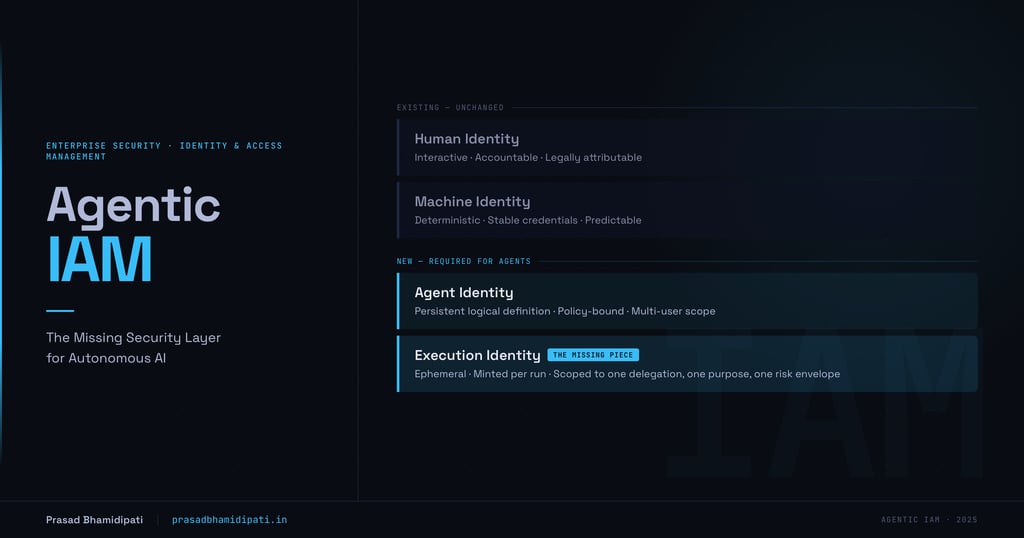
The standard IAM model recognizes two principal types. Agents require four.
The first two are unchanged. Human identity remains the traditional user (employee, customer, administrator), and machine identity remains the traditional workload (backend service, CI/CD pipeline, integration client). Neither needs rethinking.
Agent identity is where the model starts to diverge from anything IAM currently handles. This is the persistent logical definition of an agent system: "Finance Reconciliation Agent" or "Customer Support Agent." It carries policy bindings, tool access definitions, memory scopes, and governance metadata. It may operate on behalf of multiple humans. The closest existing analogs are Kubernetes ServiceAccounts and AWS IAM Roles, but those assume deterministic behavior. Agent identity must account for the fact that an agent can decide, at runtime, to do something its designer did not specifically anticipate.
The real gap, though, is one level lower: execution identity. Every autonomous run needs its own scoped identity capturing who delegated it, what purpose it serves, which APIs it may call, what budget it carries, and when it expires. An execution identity is minted when a human or another agent delegates a task, and it lives only as long as the task runs.
A concrete example makes this tangible. Alice asks the Support Agent to process a refund. The system mints an execution identity scoped to Alice's delegation, the refund workflow, a 15-minute window, and exactly two API permissions: `refund:create` and `ticket:read`. The agent cannot touch `account:delete` because the execution identity does not carry that capability. When the task completes or the window closes, the identity is gone.
This hierarchy means that identity alone is no longer the primary enforcement boundary. The delegation chain is. The security-relevant question shifts from "who is this principal?" to "what delegation chain produced this action, and what capabilities does this specific execution carry?"
Authorization becomes runtime-aware
Traditional IAM evaluates a static question: can principal P invoke API A? The answer is computed at deploy time, cached in a role binding, and assumed to hold until someone changes the policy.
Agent authorization requires a different kind of evaluation:
Should this execution instance,
acting on behalf of this user,
under this delegation context,
at this confidence level,
within this risk envelope,
with this remaining token budget,
be allowed to invoke this specific action?
That evaluation has to happen at call time, every call, because the agent's next action depends on the output of its last action. A role binding set at deploy time cannot anticipate what an agent will decide to do at minute seven of a fifteen-minute session.
The convergence point across the industry is capability-based security. Instead of assigning an agent a role like `finance_admin`, the system issues short-lived, unforgeable capability tokens scoped to specific operations, amounts, entities, and time windows. Browser sandboxing went through this same evolution when JavaScript started doing things its designers never intended. The agent execution layer faces the same problem and will land on a similar answer.
Reference architecture
A credible enterprise implementation needs five components, and they form a pipeline rather than a checklist.
At the top sits an agent registry that tracks every agent definition in the organization: its owner, allowed tools, trust level, policy set, and memory access boundaries. Without it, you cannot answer the question "what agents exist in our environment and what are they allowed to do?" Most enterprises cannot answer that question today. When a user delegates work to a registered agent, a delegation broker converts that consent into an execution-scoped credential: a capability token carrying exactly the scope, time bound, and delegation chain that the task requires. The closest existing pattern is OAuth on-behalf-of, extended with constraints that OAuth does not natively express, such as token budgets, tool restrictions, and risk envelopes.
Every request from an executing agent then flows through two enforcement layers. A policy engine (OPA and Cedar are the obvious candidates) evaluates authorization decisions against the delegation context, the prior tool calls in the session, the accumulated risk score, and the remaining budget. A tool firewall sitting alongside it mediates the actual API call, enforcing rate limits, sanitizing outputs, and blocking prompt injection from propagating through tool responses. Agents never call business APIs directly; every request goes through this gateway. The enforcement is continuous rather than one-shot, which is the key difference from a conventional API gateway.
Underneath all of this, a provenance and audit layer records the full delegation lineage for every action: who delegated, to which agent, which execution context, which tool calls, and what reasoning produced each decision. The existing telemetry stack (OpenTelemetry, structured logging) can carry most of this, but the schema needs delegation chains and decision context as first-class fields. Without provenance, you can neither investigate incidents nor attribute behavior.
These five components sit above your existing IAM stack. Spring Security, Entra ID, Okta, your OAuth2 resource server all remain in place. The agent security layer speaks their protocols while adding delegation, autonomy constraints, and execution-scoped enforcement.
Where you probably stand today
Most enterprises are in the earliest phase of this evolution, where agents are treated as service accounts holding long-lived credentials with broad permissions. Security teams cannot distinguish agent-initiated actions from regular API traffic, and audit trails show the service account rather than the human who delegated the task or the reasoning that produced the action. This works with three agents in a sandbox but collapses with three hundred in production.
The more mature organizations will move, over the next twelve to eighteen months, toward treating agents as delegated principals with OAuth-based delegation, consent screens, and scoped tokens. Microsoft's Entra agent guidance and the MCP authorization spec both operate at this level, and it is a real improvement. But it still assumes that delegation scopes set at session start remain appropriate for every action the agent takes during that session. For agents that chain tools and synthesize new requests mid-execution, that assumption breaks down.
The stable long-term architecture will treat every agent execution as a constrained capability sandbox with short-lived tokens, continuous policy evaluation, per-call authorization, and full provenance. Container security went through this exact progression (from shared root to namespace isolation to capability-constrained runtimes), and the agent security problem will resolve the same way, because the underlying challenge is the same: governing code that makes decisions you did not pre-approve.
Five things to do before your next architecture review
Start by inventorying your agent footprint. Identify every agent or agent-like system in your environment and document what credentials it holds, what APIs it can reach, and who is responsible for its behavior. You cannot govern what you have not mapped.
Then separate agent identity from execution identity in your data model, even if your current system cannot yet enforce execution-scoped credentials. Build the distinction into your schemas, your logs, and your threat models now. Retrofitting this later is significantly more expensive than getting the data model right up front.
The single highest-leverage architectural change is putting a gateway between your agents and your business APIs. Every agent request goes through a mediation layer that can enforce policy, rate-limit, and log. That decision alone covers most of the security surface area.
On the audit side, extend your log schema so that every agent action entry answers: who delegated this task, to which agent, under what scope, and what prior actions in this session preceded it. Your existing SIEM can ingest this if you structure the fields correctly.
Finally, begin evaluating OPA, Cedar, or an equivalent policy engine for runtime agent authorization. Your current RBAC policies cannot express the constraints that agents need. Runtime policy evaluation against execution context is where the enforcement model is heading, and the tooling is mature enough to pilot today.
--------------------------
The missing primitive in enterprise IAM is delegated ephemeral execution identity: a short-lived, capability-bearing security context minted for one run, one purpose, and one risk envelope. Building this layer is the difference between AI agents that are governable at enterprise scale and AI agents that are not.
Expert articles on AI and enterprise architecture.
Connect
prasadbhamidi@gmail.com
+91- 9686800599
© 2024. All rights reserved.